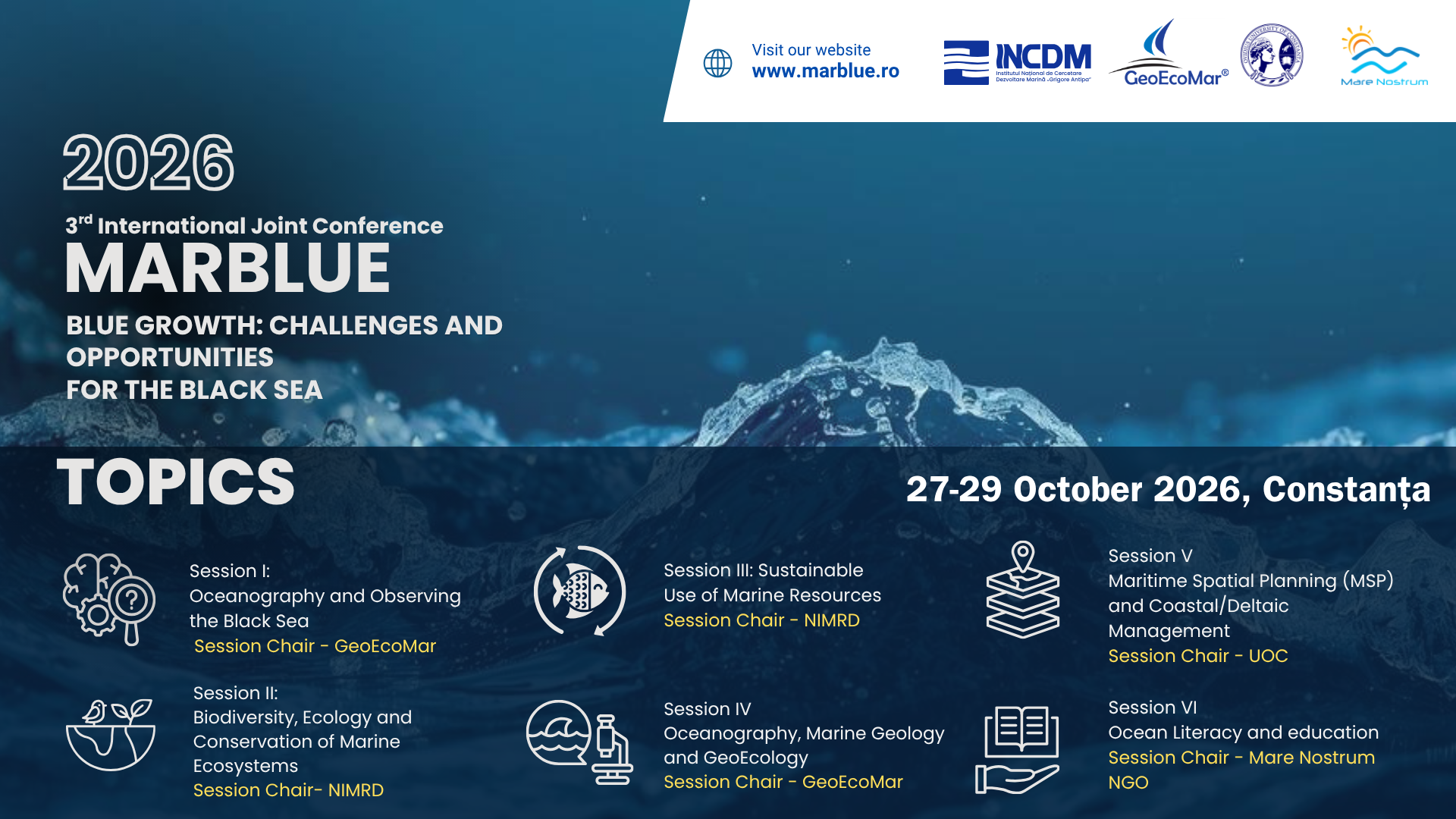
About Conference
The aim of the International Conference is to contribute to the protection of the Black Sea by supporting the sustainable development
in a multi-disciplinary way. The conference will provide a space for fruitful discussions, including aspects related to both
fundamental research as well as technological innovations, between scientists as well as companies involved in research and
development.
PRESENTATION FORMS:
• session lectures (20 min)
• lectures (10 min)
• posters A0
Location
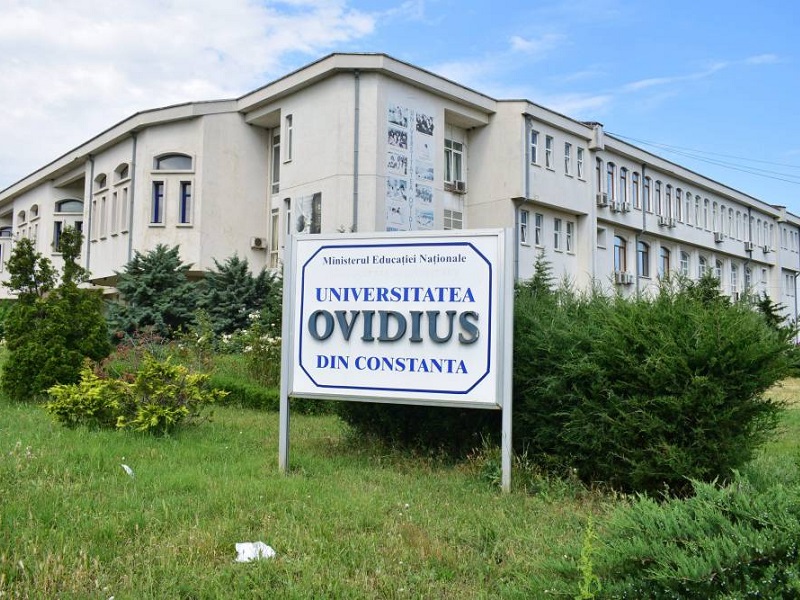
”OVIDIUS” UNIVERSITY OF CONSTANTA
1 University Alley, B Campus, A3, floor 1
900437, Constanta, Romania
When
27-29th October, 2026
Registration Fees & Payment Information
We invite participants to register for MARBLUE 2026- BLUE GROWTH: CHALLENGES AND OPPORTUNITIES FOR THE BLACK SEA
Please take note of the registration deadlines to benefit from reduced rates.
The registration fee covers access to all scientific sessions, symposium materials, coffee breaks, and official ceremonies.
• Standard Fee: 75 EUR (Available until September 15, 2026)
• Student Fee: 50 EUR (Valid for undergraduate, master, and PhD students; proof of student status is required).
All payments must be made via bank transfer in RON (at the exchange rate of the payment day). Please include the mention:
" MARBLUE 2026- BLUE GROWTH: CHALLENGES AND OPPORTUNITIES FOR THE BLACK SEA "
• IBAN: RO93 INGB 0000 9999 1964 0185
• Bank: ING Bank
• Beneficiary: ONG Mare Nostrum
MARBLUE 2026 Student Sponsorship Opportunity
We are thrilled to announce that 10 students will receive fully subsidized registration fees for MARBLUE 2026!
Selected candidates will have their fees completely covered, making it easier to join this important event. To be considered for one of these sponsored spots, please make sure to fill out the application form by September 07.
Important Note: The sponsorship for this subsidy is proudly provided by Publi24 through the Mare Nostrum NGO.
How to Apply:
- Review the eligibility requirements.
- Complete the application form by September 7 using the link below.
EVENT SPEAKERS
Our speakers
Şükrü Turan Beşiktepe
Designation: Professor
Position: Head of the Marine Sciences Department
Affiliation: Institute of Marine Sciences and Technology of Dokuz Eylül University, Türkiy
Web: https://imst.deu.edu.tr/en/
Nina Dzhembekova
Designation: Associate Professor
Position:
Affiliation: Institute of Oceanology, Bulgarian Academy of Sciences
Web: https://Институт по океанология "Фритьоф Нансен" – Българска Академия на Науките
Eugen Cătălin Platon
Designation: Aquaculture engineer
Position: President
Affiliation: ROMFISH
Web: https://www.facebook.com
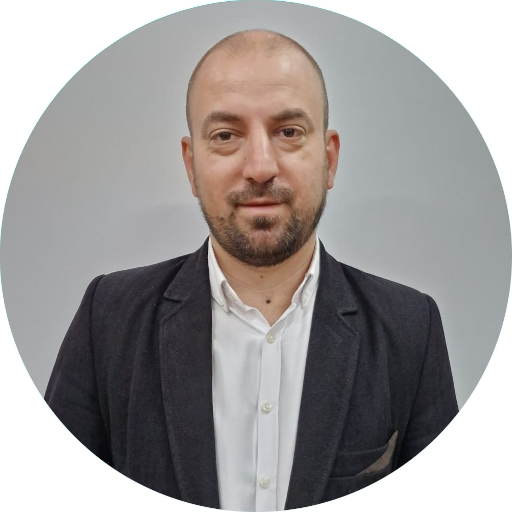
Ioan Munteanu
Designation: Lecturer, Dr.
Position: Vice Dean of the Faculty of Geology and Geophysics
Affiliation: Faculty of Geology and Geophysics, Romania
Web: https://gg.unibuc.ro/

Edward Anthony
Designation: Professor
Position: Professor of Physical Geography – CEREGE, Aix-Marseille University
Affiliation: DELTA-HUB ERA
Web: https://www.univ-amu.fr
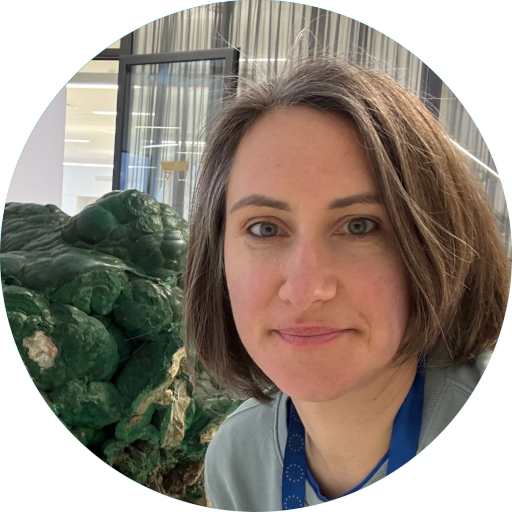
Dominika Wojcieszek
Designation: Research Scientist
Position: Project Manager
Affiliation: European Marine Science Educators Association
Web: https://www.emseanet.eu
Event Venue
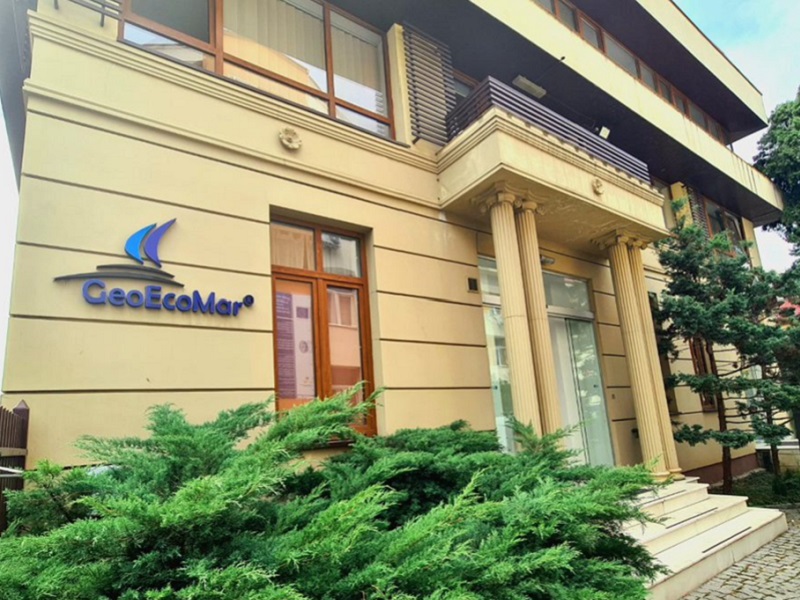
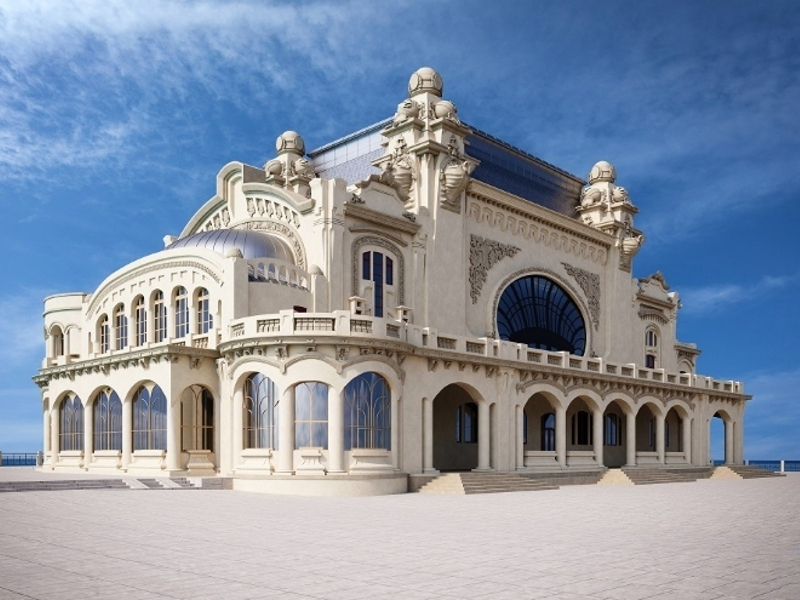
Event venue location info and gallery
Programme
-
Final Programme and Book of Abstracts
Participants are invited to download the Agenda by pressing the button below and to check their position in Oral Presentations:
 Final Agenda
The program will continue to be updated
Final Programme
Book of Abstracts
Final Agenda
The program will continue to be updated
Final Programme
Book of Abstracts
-
Poster Presentations
The participants will have the opportunity to communicate their research results through posters presentations: Padlet Link -
Join Us Online
You are welcome to join us online at: Webex Link
Scientific Commitee
Organising Committee
Info
- Templates for Posters and Presentations
-
Registration Form
Don’t forget to register for the conference before submitting your abstract by filling in Registration form.
Deadline for event registration: September 16th, 2026
Other important deadlines:
- Extended deadline September 7 2026: Deadline for abstract submission
- Extended deadline September 15 2026: Notification on abstract submission acceptance
-
Abstract Submission
- Submission of abstract can be made ONLY through the online submission by filing in the fields below and attaching Microsoft Word abstract file.
- This form can be used for both: Oral and poster presentations.
- Only a corresponding author should submit an abstract.
- One author registered for the conference may submit up to two abstracts.
Send email at marblue@nimrd.roPlease use the following guidelines (abstracts which do not follow guidelines will be returned to the author for correction).
TITLE (no more than 20 words): Uppercase, Times New Roman, Font size 12, Bold, Center text
AUTHORS NAME: Uppercase, Times New Roman, Font size 11, Center text. Presenting author underlined.
AFFILIATION (Make sure that the presenting author’s e-mail address is in the affiliation): Times New Roman, Font size 11, Italic
e.g.,
1Affiliation name and address 1
E-mail address of the presenting author (e.g. ionescu@xx.xx)
2Affiliation name and address 2
ABSTRACT TEXT(Not exceeding 300 words): Times New Roman, Font size 11, Justify, finally listing at least five keywords, excluding words from the title.
Deadline for abstract submission: September 7, 2026
Notification of acceptance: September 15, 2026
Abstracts will be submitted via e-mail at the address: marblue@nimrd.ro
-
Deadlines for registration and abstract submission
• Extended deadline September 7, 2026: Deadline for abstract submission
• Extended deadline September 15, 2026: Notification on abstract submission acceptance
Please send your abstracts directly via email to: marblue@nimrd.ro.
To ensure a smooth review process, please include "Abstract Submission - [Your Name]" in the subject line of your email.
-
MARBLUE 2026 FULL PAPERS Publication Options
Presented papers will be published in peer-reviewed academic open access journals:
Publication Disclaimer: Please note that the opportunity to publish full papers in Journal Cercetari Marine / Recherches Marines for 2027 edition is a completely independent process from the conference proceedings. While we highly encourage participants to submit their manuscripts, all work will be subject to the journal’s own formal peer-review process. Consequently, acceptance to or participation in the conference does not guarantee publication in the journal.
-
Fees
The registration fee covers access to all scientific sessions, symposium materials, coffee breaks, and official ceremonies.
• Standard Fee: 75 EUR (Availble until September 15, 2026)
• Student Fee: 50 EUR (Valid for undergraduate, master, and PhD students; proof of student status is required).
All payments must be made via bank transfer in RON (at the exchange rate of the payment day). Please include the mention: " MARBLUE 2026- BLUE GROWTH: CHALLENGES AND OPPORTUNITIES FOR THE BLACK SEA "
• IBAN: RO93 INGB 0000 9999 1964 0185
• Bank: ING Bank
• Beneficiary: ONG Mare Nostrum
Topics
Session I: Oceanography and Observing the Black Sea, Session Chair - GeoEcoMar
A crucial element of the Black Sea restoration and rehabilitation initiatives is the implementation of a continuous monitoring and operational
observing system in the Black Sea. Regular observations in the Black Sea basin started in the past century and quite a good multidisciplinary
observing system operated in the 1970–1980s, mainly based on ship observations. Since then, many projects and initiatives have dealt with
technological opportunities for improving both satellite and in situ infrastructures, able to support the R&D activities such as the modeling
and assimilation capabilities, validation and verification of modeling and satellite products, real time monitoring, estimation of quality of
physical variables, etc.
This session aims to increase the awareness of the importance of observation capacities in the Black Sea and
highlight the progress made so far.
Join the discussion on the future of marine monitoring—submit your abstract to contribute to our collective observation strategy.
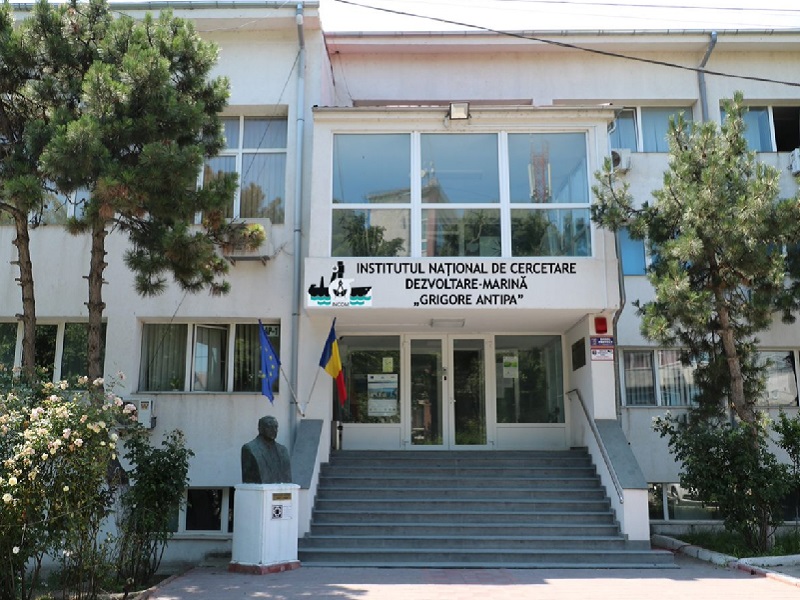
Session II: Biodiversity, Ecology, and Conservation of Marine Ecosystems, Session Chair - NIMRD “Grigore Antipa”
Marine ecosystems are subject to a variety of threats including disease, pollution, climate change, habitat alteration, overexploitation,
and invasive species. Various conservation approaches are used to protect these ecosystems and involve monitoring, management, and international
cooperation. Understanding the fundamental components as well as the interactions between aquatic organisms and their environment can help to
better understand and conserve marine ecosystems.
The session “Biodiversity, Ecology and Conservation of Marine Ecosystems” aims
to bring together leading academic scientists and researchers to exchange and share their research results, latest findings, achievements and views
on marine biodiversity, ecology and conservation.
Share your latest findings on ecosystem resilience—apply now to present your research to a global audience of specialists.
Session III: Sustainable Use of Marine Resources, Session Chair - NIMRD “Grigore Antipa”
Although the Black Sea is a unique basin that is rich in biodiversity, heritage and natural resources, it is increasingly under pressure
due mainly to the impacts from human-induced factors, such as eutrophication and hypoxia, overfishing, and introduction of alien species,
in addition to the effects of climate change. For these reasons, the sustainable use of the Black Sea resources is of utmost importance
and research in these areas is essential.
This section covers topics focusing on living resources (fisheries, aquaculture, biotechnologies
etc.) and non-living potential (mineral resources, energy, cultural heritage, tourism etc.), aiming at fostering the “blue transformation“
of the Black Sea.
Be part of the "Blue Transformation"—contribute your expertise on sustainable resource management today.
Session IV: Marine Geology and GeoEcology, Session Chair - GeoEcoMar
The Black Sea serves as the largest anoxic basin in the world, preserving a complex geological record established over the last 250 million years.
This session focuses on the basin's tectonic and sedimentological evolution, specifically the intermittent connectivity with the Mediterranean that
has left distinct lithological and geochemical imprints on the seabed. Discussions will cover the significant changes in fauna and flora composition
from the Last Glacial Maximum through the Holocene, alongside the basin’s importance regarding potential hydrocarbon source rocks and unconventional
resources like gas hydrates. Furthermore, the session addresses the geoecological state of the basin today, examining the presence and behavior of
various pollutants within the geological framework and their impact on the contemporary marine environment.
Uncover the geological secrets of the Black Sea—submit your paper to lead the conversation on this topic!
Session V: Maritime Spatial Planning (MSP) and Coastal/Deltaic Management, Session Chair - UOC
The development of coastal/deltaic areas and maritime space is a priority in the European Union together with its European Ocean Pact and sustainable
blue economy aims. In the global context of resource depletion, climate change and biodiversity loss, the sustainable use of marine resources is a key
issue in the framework of important regulations to be adopted through maritime spatial planning and coastal/deltaic processes, as well as land-sea
interactions.
This session aims to emphasize sustainable blue economy policies and actions as a society response to current challenges in the Black Sea basin while
building a collaborative long-term and integrated strategy of maritime space and coastal/deltaic areas development, based on the transfer of knowledge
and innovation.
This session aims to raise awareness on the conservation, restoration and sustainable use of the Black Sea and its resources and to build an improved
public knowledge base across the world's population regarding our global ocean.
Shape the future of coastal development—register now to collaborate on integrated maritime strategies.
Session VI: Ocean Literacy and Education, Session Chair - Mare Nostrum
Ocean Literacy represents the understanding of the ocean’s influence on us and our influence on the ocean, as well as the importance of the
ocean to humankind, communication about the ocean in a meaningful way and responsibility about decisions regarding the ocean and its resources.
Moreover, ocean literacy is not just educating or informing the public and the marine and maritime stakeholders about the importance of oceans -
ocean literacy aims at facilitating the creation of an ocean literate society. Ocean literacy in the Black Sea region is a crucial aspect of
understanding and conserving this unique marine environment.
Key points regarding ocean literacy in the Black Sea are representing by environmental challenges, biodiversity, education, research and collaboration.
This session aims to raise the awareness on the conservation, restoration and sustainable use of the Black Sea, enhancing Ocean Literacy concept
to build an improved public knowledge by actively engaging with all the stakeholders.
Empower the next generation of ocean advocates—submit your educational initiatives and help build an ocean-literate society.
Hosts


Event held under the auspices of:
The Romanian National Authority for Research
In partnership with:

Main sponsors:



Sponsors:



Hotels
Rates can change. Check daily rates!
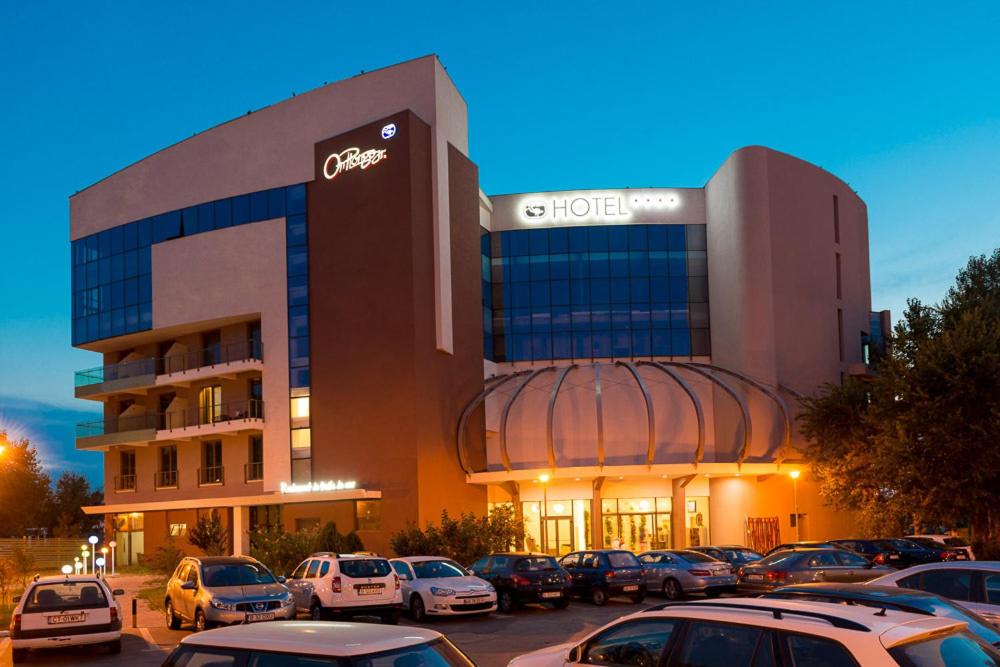
Hotel On Plonge Junior
Location
Mamaia Blvd., at the entrance in Mamaia resort, 1.1 km distance from University Campus
Rates
Double room 64 Euro/night (breakfast included)
Single room 58 Euro/night (breakfast included)
Contact
tel. +40 724 368 327
E-mail: reservationsonplongejr@yahoo.com
Note:
All conference participants are entitled to a personalized discount code. For more
information on how to obtain and use your code, please inquire at the reception desk or contact the MARBLUE organizing
committee.
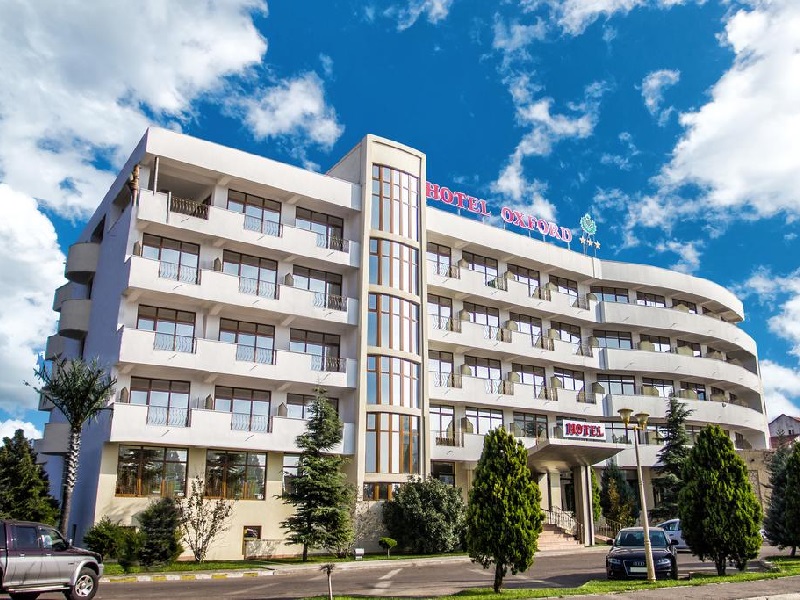
Hotel Oxford
Location
202A Al. Lapusneanu Blv., near the roundabout entrance to Mamaia resort from Constanta area, near the Holiday Village,
0.5km distance from University Campus
Rates
Standard Double room 55 Euro /night – (breakfast included)
Single room 45 Euro/night (breakfast included)
Contact
tel. +40 241 606 510
Mobile: +40 735 333 103
E-mail: rezervari@hoteloxford.ro
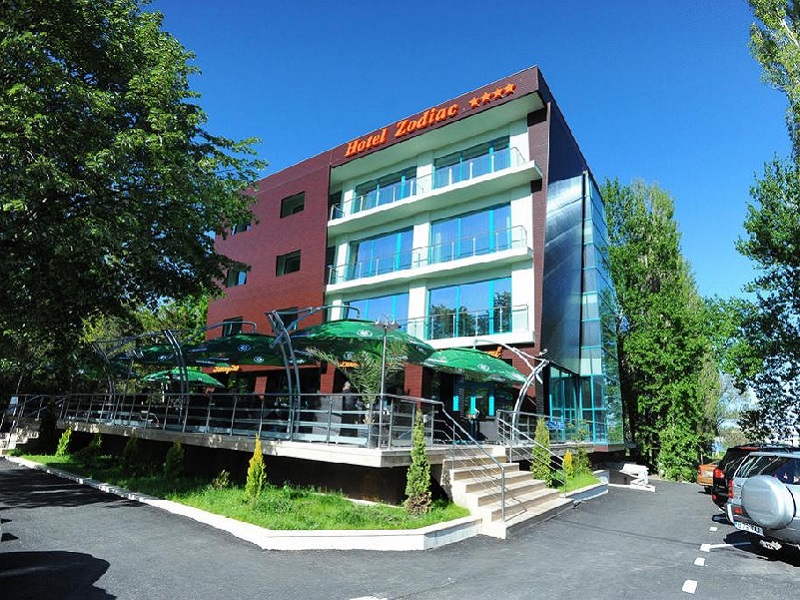
Hotel Zodiac
Location
Al. Lapusneanu Blv., very close to Tabacarie Park, 0,8 km distance from University Campus
Rates
Standard Double room 55 Euro /night – (breakfast included)
Single room 45 Euro/night (breakfast included)
Contact
tel. +40 241 517 051
E-mail: receptie@hotelzodiac.ro